


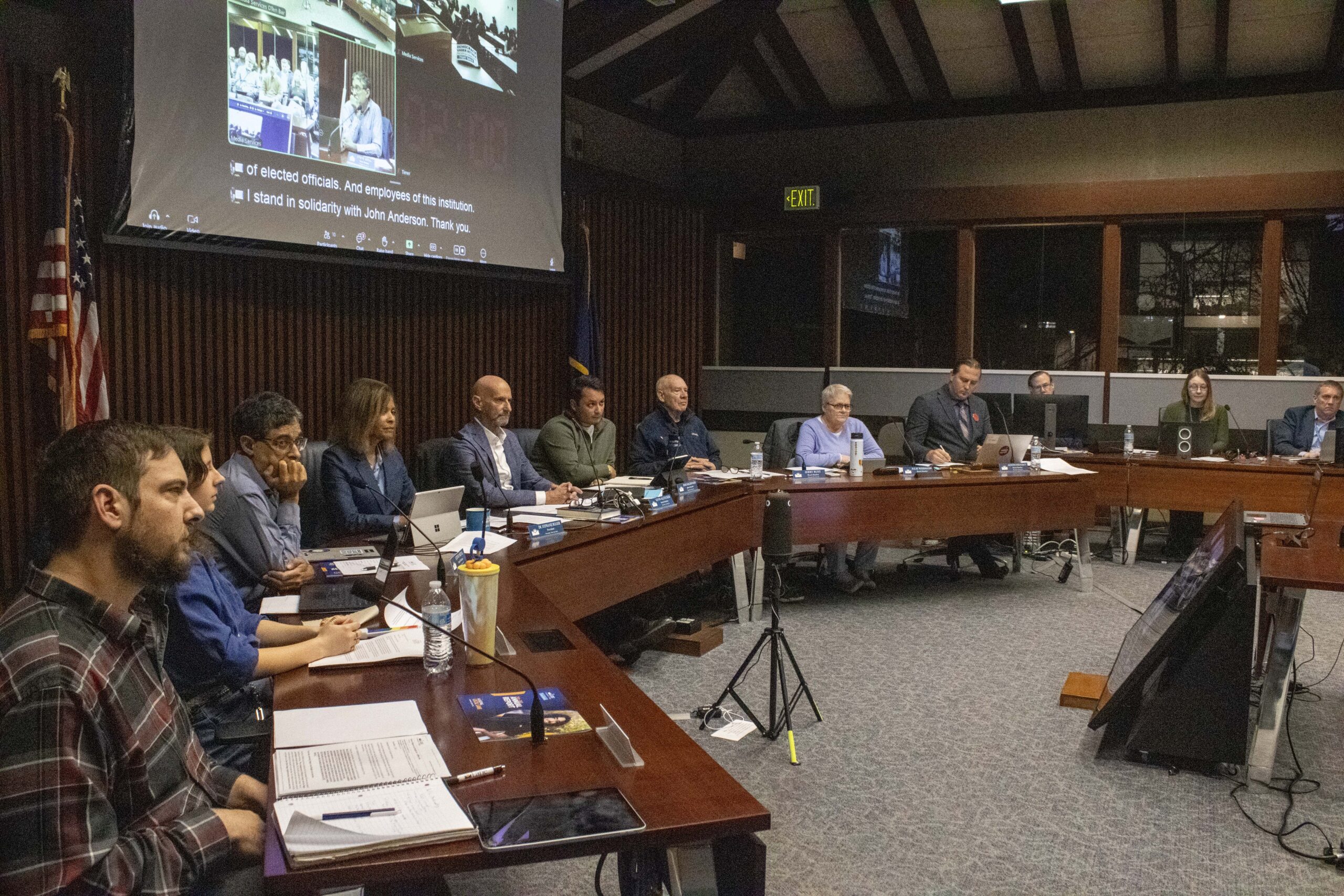
Dec. 3 Lane Community College Board of Education meeting. Photo by Kat Tabor.
A packed board meeting stretches to 11:30 p.m. as members debate reports, public comment and the college’s three-year financial future
By Kat Tabor
Staff, faculty and community members again filled the boardroom and overflow areas during the Dec. 3 Lane Community College Board of Education meeting, with all board members present in person. Following the land acknowledgment, the meeting quickly turned contentious as board members quarreled over public comment, strategic planning and financial planning.
There has been rising tensions between board members since the board failed to appoint a replacement for Lisa Fragala after she was elected to the Oregon Legislature. The board has been dogged by allegations of bullying, and meetings have reflected disagreements over the roles of the administration and the board itself in governing LCC.
Recent board meetings have seen a sharp increase in public comment amid ongoing contract discussions involving the Lane Community College Education Association faculty union. Public comment has exceeded an hour on multiple occasions.
Board member Kevin Alltucker opened by requesting a motion to add a statement before public comments, saying “the flavor of the statement is not to attack the person but to explore the issue.” The board approved adding it to the agenda.
Alltucker then moved to limit to three minutes verbal testimony from the president’s report, the LCCEA report, the Lane Community College Employee Federation (LCCEF) report and the student government president’s report, saying he worried about the meeting “going into the wee hours of the night.”
The motion failed.
Board member Julie Weismann instead asked to move the reports later in the meeting, saying, “Other discussion items are really important.” She noted the reports are available in written form and said she agrees with Alltucker about prioritizing “more important” items. “It’s not to stop the comments, it’s to just put them in a different agenda order so we can talk,” Weismann says.
Board Chair Austin Fölnagy says he is worried about having student voices not having an opportunity to be represented if the reports get moved down, but Student Government Association president Amelia Hampton said, “I feel comfortable having my report stated later, like it was said earlier, they are all in written form.” The motion was then passed with chair Fölnagy and board member Zachary Mulholland voting no.
Board member Steve Mital then requested a motion that public comment be divided up, with the first half being limited to one hour, then resume the rest of it for later in the meeting. Vice-Chair Jerry Rust said he felt uncomfortable with this because the public hasn’t been informed of the change ahead of time, and they are already there, he said “I’d prefer we have a subcommittee look at this whole issue.”
And Fölnagy echoed this by saying, “Yes, we have not notified the public ahead of time, and I want to hear from people.” Fölnagy continued, “That’s board work, it’s good work, and I absolutely want to hear from people.” Mulholland added, “We all agreed to the process last year. I would like to move forward with the process that I planned when I came to the meeting.”
Alltucker clarified that he doesn’t want to change policy, just have this change be a one-time thing because of the full agenda ahead of them in the meeting.
The board didn’t pass Mital’s motion.
Alltucker then delivered his statement, which had been added to the agenda before public comment. He addressed the increasing number of remarks directed at LCC President Stephanie Bulger, saying, “I want to remind us all that this chamber is meant for thoughtful participation, not the urge to take aim at the person, especially when we are entrusted to support the institution and the president who carries out our direction.”
He added that his comment is meant to “critique the policies, challenge the decisions and question the strategy,” continuing, “that’s the work of a healthy community.” Altucker said, “I don’t want a repeat of what happened on Nov. 5th when public testimony tipped into hostility for the president. This cannot happen again.”
Administrators presented a three-year financial mitigation plan aimed at restoring the General Fund’s ending balance to the 10% reserve required under Board Policy 6230 by 2029. Bulger, Director of Budget, Grants and Resource Planning Jonathon Campbell, and Vice President of Finance and Operations Kara Flath outlined $8 million in phased structural reductions and strategic investments, projecting a 10.40% ending fund balance by 2029.
Campbell emphasized the distinction between a financial forecast and a budget, describing the forecast as “dynamic” and based on the best available data at a given time, while noting that the budget follows Oregon budget law and is a more “static” document set annually. His explanation addressed concerns raised by the Lane Community College Education Association, whose president, Adrienne Mitchell, said in a press release that approving the plan could risk non-compliance with Oregon Local Budget Law.
Campbell emphasized that the item before the board is not a budget but a “forecast.” According to QuickBooks, “Budgeting provides a roadmap for allocating resources and managing cash flow, while forecasting enables businesses to anticipate market conditions and make proactive decisions.” The forecast is not set in stone.
During the forecasting presentation, Mulholland said key information was missing, noting, “I feel very uncomfortable not knowing the costs, benefits and the trade-offs of what we are being asked to do. It’s very laudable to try and restore ending fund balance to try and have the surpluses that we could then rededicate to other funding needs like deferred maintenance.”
He added, “We are being asked to approve very large reductions in theory and it gives me cause for concern.” Mital agreed, saying, “You’re asking us to give you strategic direction and to empower you to make some decisions on cuts so I think we all need to be aware if you do that,” and, “If you’re going to bring back to us some recommendations for rightsizing cuts, we should be fully aware of that.”
A letter from the Tedesco Law Group was submitted to the board by Mitchell, who consulted attorneys Luke Kuzava and Evianna Colvin and presented the letter to support the legal arguments in her report during the Sept. 30 meeting earlier this year.
In a press release, Mitchell said the letter from “attorneys Luke Kuzava and Evianna Colvin … was provided to you [the board] on September 30, 2025, on this very same topic.” The Sept. 30 meeting, however, did not involve the same action item present at the Dec. 3 meeting. Mitchell quoted Kuzava and Colvin as saying, “Given the circumstances, I want to be as clear as I can be on this point: the LCC Board of Education plainly has no legal authority to approve any proposed budget cuts,” a statement that applies to budgets, not forecasts.

Flath said the plan will move to the budget development subcommittee, College Council and the board by March 2026. She added that early approval could prevent months of wasted work. “But first we need to know if the board is approving the three-year plan we are bringing forward,” she said. “What we don’t want to do is do the next three months of work bringing a $3 million plan forward and have the board disapprove that.” Bulger added, “This is where the board is able to set a strategic direction for the institution. This is critically important work for the board.”
During the forecasting presentation, Mulholland said key information was missing, noting, “I feel very uncomfortable not knowing the costs, benefits and the trade-offs of what we are being asked to do. It’s very laudable to try and restore ending fund balance to try and have the surpluses that we could then rededicate to other funding needs like deferred maintenance.”
He added, “We are being asked to approve very large reductions in theory and it gives me cause for concern.” Mital agreed, saying, “You’re asking us to give you strategic direction and to empower you to make some decisions on cuts so I think we all need to be aware if you do that,” and, “If you’re going to bring back to us some recommendations for rightsizing cuts we should be fully aware of that.”

At-large member Jesse Maldonado said he wanted another work session and appreciated “all the work that you all have put in here,” adding, “It’s not that I disagree with this or that I don’t trust you all … but there is just more clarification that I have before I feel comfortable saying ‘here’s how we are going to cut all this money.’ ”
Alltucker countered, “This is exactly what we asked for and I am comfortable with the high-level policy type of view that is being presented here. I would be uncomfortable with looking at line item individual programs at this point.”
Some members suggested delaying the vote, but Weismann objected, saying the board already approved this process in June and accreditation could be at risk. “We are now putting that in jeopardy,” she said. “We are not thinking about the college’s sustainability, about its reputation, and about what we do as a board.” She added she is “extremely concerned about the future of this institution if the majority will keep kicking things down the road because it serves a particular narrative.”
The board ultimately voted to let the finance team continue developing the plan, with the requirement that it return as an action item in January 2026. Alltucker and Weismann voted no; the motion passed by a majority.
With 54 people signed up for public comment, the board limited remarks to two minutes, giving students priority. Public comment lasted more than two hours, and the meeting ended around 11:30 p.m.


